How to Buy Certified Diamond Jewellery in India (2026)
If you’ve never bought diamond jewellery before, the experience can feel a bit like buying your first car. Everyone has opinions. Every shop promises the same thing. The vocabulary — carat, clarity, hallmark, HUID, certified, lab-grown, BIS — gets thrown at you with the assumption you already know what it means.
You don’t. And that’s fine.
This guide is the one we wish we could send to every new buyer who walks into our store. It’s written from the perspective of a family jeweller in Delhi who has been selling gold and diamonds since 1996. No upselling, no industry jargon, no ‘buy now before the price goes up’ pressure.
By the end of it, you’ll know how to spot a properly certified diamond, what BIS hallmark and HUID actually mean, what to ignore, and roughly how much you should be paying for what you want.
What ‘Certified’ Actually Means
When a jeweller says ‘this is a certified diamond,’ they should mean two separate things — not one.
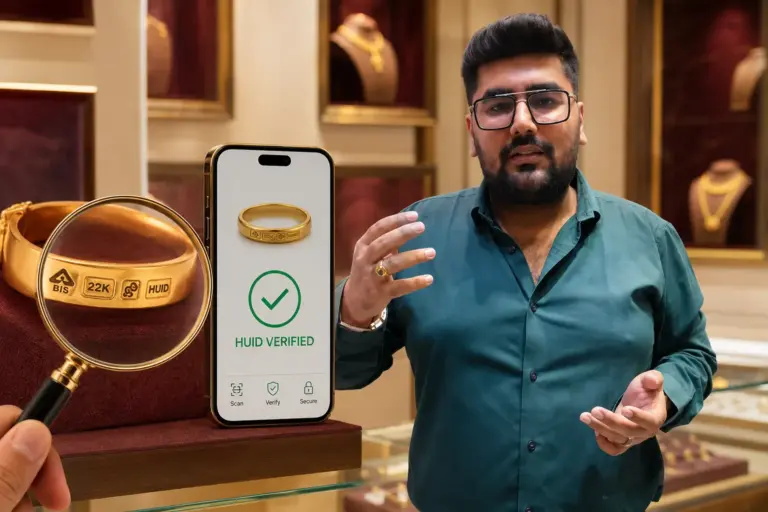
The gold is BIS hallmarked with HUID. The Bureau of Indian Standards certifies that the gold in the piece is the karat it claims to be — 14KT, 18KT, or 22KT. The HUID (Hallmark Unique ID) is a six-character code laser-marked on every hallmarked piece since 2022, traceable through the BIS Care app. If a jeweller can’t show you the HUID, walk away.
The diamond is independently certified by IGI, SGL, or GIA. These are third-party labs that grade the diamond’s cut, clarity, colour, and carat weight. The certificate is a separate physical document that comes with the piece. The diamond itself is laser-inscribed with the certificate number on its girdle (the edge), invisible to the naked eye but verifiable under magnification.
Both are non-negotiable for any diamond piece above ₹15,000. If you’re getting only one — or worse, just a ‘trust us’ assurance from the shop — you’re not buying certified jewellery.
The 4Cs, Without the Sales Pitch
The 4Cs (cut, clarity, colour, carat) are the language diamonds are graded in. Most buying guides treat them like sacred truths. They’re actually just trade-offs.
Carat is weight, not size. A 0.50 carat diamond looks a certain way; a 1.00 carat looks bigger but is significantly more expensive because price scales non-linearly with carat. Going from 0.20ct to 0.30ct is a small premium; going from 0.90ct to 1.00ct can double the price. If budget matters, sit at 0.20-0.30 carat — looks beautiful, costs sensibly, and gives genuine sparkle.
Cut is the only C the cutter controls — everything else is the rough stone Mother Nature handed over. Cut grade matters more than people realise. A well-cut SI diamond will out-sparkle a poorly-cut VVS diamond every time. Look for ‘Excellent’ or ‘Very Good’ cut on the certificate.
Clarity ranges from FL (flawless) to I3 (heavily included). For everyday jewellery — earrings, pendants, daily rings — SI1 or SI2 is the sweet spot. Inclusions are invisible to the naked eye, prices are reasonable, and most buyers can’t tell the difference between SI and VVS without a loupe. Paying for VVS clarity on a 0.15-carat earring is paying for something nobody will ever see.
Colour runs D (colourless) to Z (visibly yellow). In Indian buying, G-H-I range is the most common — near-colourless, looks white in normal light, costs roughly 30-40% less than D-E-F grades. Save the D-grade colour for solitaire engagement rings if that matters to you; otherwise G-H is genuinely fine.
A quick honest rule: for most daily-wear diamond jewellery, 0.15-0.30 carat, SI clarity, G-H colour, Excellent cut gives you 90% of the visual impact at 50% of the price of ‘premium’ specs. Save the difference for a better setting or a second piece.
The Hallmark Story in Plain English
The Bureau of Indian Standards started mandatory gold hallmarking with HUID in mid-2021, fully enforced by 2023. Every piece of gold jewellery sold in India today must carry:
• The BIS logo
• The karat indicator (14K916, 18K750, 22K916)
• The jeweller’s identification mark
• The six-character HUID code
You can verify any HUID by downloading the BIS Care app from the Play Store or App Store, entering the code, and reading the full report on that piece — including which jeweller registered it, when, and at what karat. This is your single most powerful consumer protection in Indian jewellery buying. Use it.
If a piece doesn’t have a HUID, it’s either pre-2021 inventory (which should be re-hallmarked before sale) or it’s not legitimately hallmarked. Don’t buy it.
What About Lab-Grown vs Natural Diamonds?
Lab-grown diamonds are real diamonds, chemically and physically identical to mined diamonds, grown in a controlled lab environment over 6-10 weeks. They cost 60-80% less than mined diamonds of equivalent specs.
The honest take:
For everyday jewellery (under ₹50,000), lab-grown is excellent value. You get a bigger, cleaner diamond for the same money, and most jewellery in this price range is bought for wear, not investment.
For milestone pieces (engagement rings, anniversary necklaces, heirlooms), mined diamonds still hold cultural and resale value that lab-grown doesn’t yet. Whether that matters depends on your priorities.
What’s not acceptable is a jeweller selling you a lab-grown diamond at mined-diamond prices. Both should come with certification clearly stating the diamond’s origin (IGI marks lab-grown stones explicitly on the certificate). Always check.
How Much Should You Actually Pay?
Diamond jewellery pricing breaks down into roughly:
• Gold weight × current rate (e.g., 5g of 18KT × ₹6,500/g = ₹32,500)
• Diamond cost (varies by 4Cs — typically ₹15,000-₹40,000 for 0.20-0.30ct daily-wear quality)
• Making charges (the jeweller’s craftsmanship fee — typically 8-15% of gold value)
• GST at 3% on the total
A reasonable price for a daily-wear diamond ring with a 0.15-0.20ct stone in 18KT gold is ₹22,000-₹35,000. A statement diamond bangle in 18KT with multiple diamonds totalling 1-2ct sits at ₹80,000-₹1.5 Lakh. A premium diamond necklace with significant carat weight runs ₹2.5 Lakh upwards.
If you’re being quoted significantly above this range without a clear explanation (premium designer, exceptional carat weight, certified premium-origin stones), ask why. Good jewellers will explain.
If you’re being quoted significantly below this range, ask harder questions. Especially about hallmarking and certification.
What to Skip
In our experience, these are the things buyers regret most:
• Paying for VVS or higher clarity on small daily-wear diamonds. Nobody can see the difference.
• 22KT gold for everyday diamond rings. Beautiful gold colour, but soft — it scratches, bends, and shows wear quickly.
• Going up a carat size just because the price difference seems small. Most regret-buyers wish they’d gone smaller and saved.
• Mismatched sets that you’ll wear maybe twice a year. Poor value compared to two separate pieces you’ll wear weekly.
• Buying without comparing 2-3 jewellers. Even a 5% price difference on a ₹50,000 piece is meaningful.
How to Buy Online (Without Getting Burned)
Buying real diamond jewellery online is now mainstream in India, but it does require a few precautions:
• Verify the jeweller’s HUID registration on the BIS website.
• Ask to see the certificate before purchase.
• Use the video consultation option if available.
• Check the return policy — at least 7-day returns on unworn pieces with the certificate intact.
• Check buyback terms upfront.
Where to Start Looking
If you’re at the beginning of your diamond-buying journey, start by browsing categories that match your intended use:
For everyday-wear diamond jewellery in the ₹20,000-₹50,000 range, the categories worth exploring are diamond rings , diamond earrings , diamond pendants , and diamond nose pins — all sit in the daily-wear price bracket.
For statement and milestone purchases above ₹50,000, look at diamond bracelets , diamond mangalsutra , and statement diamond necklaces — these are where craftsmanship and certification matter most.
Final Thought
Buying your first piece of diamond jewellery is a small moment that will outlast almost everything else you buy in your twenties or thirties. The phone will be replaced in three years. The car in seven. The piece you choose this week, if you choose it well, will still be in rotation thirty years from now.
That’s worth slowing down for. Read the certificate. Verify the HUID. Compare two jewellers. Ask the questions you’re worried about asking. The good ones will answer them gladly.
And if you’re in Delhi, we’d love to show you what considered diamond jewellery looks like in person. Visit any of our 4 stores — Krishna Nagar, Karol Bagh, Shahdra, Laxmi Nagar — or book a free video consultation. No minimum spend, no pressure, no rush. Just answers.