BIS Hallmark & HUID — How to Verify Gold Purity Before You Buy
What Is BIS Hallmarking?
BIS stands for the Bureau of Indian Standards — India’s national standards body. Since June 2021, all gold jewellery sold in India must be BIS hallmarked by law. Since April 2023, that mandate has been fully enforced across the country.
Hallmarking means that a piece of gold has been tested by a BIS-recognised assaying centre to confirm that it is exactly the karat purity the jeweller claims — 14KT, 18KT, or 22KT. It’s a legal guarantee, backed by third-party verification, that you’re getting the gold you’re paying for.
Before hallmarking became mandatory, adulteration was rampant. A jeweller could label a piece ’22KT’ and actually sell you 20KT — you’d never know without independent testing. Hallmarking closes that loophole for good.
What Is HUID?
HUID stands for Hallmark Unique Identification. It’s a six-character alphanumeric code laser-marked on every hallmarked piece since July 2021. Each HUID is unique to that specific piece of jewellery — like a chassis number for a car.
The HUID lets you trace exactly where the piece came from: which jeweller registered it, at what assaying centre it was tested, on what date, at what karat.
You’ll find the HUID etched onto:
- The inside of rings and bangles
- The clasp or back of pendants and chains
- The post of nose pins and earrings
- The back or clasp of necklaces and mangalsutras
The engraving is small but legible — you might need reading glasses or a phone camera zoom to see it clearly.
The Four Marks You Should See
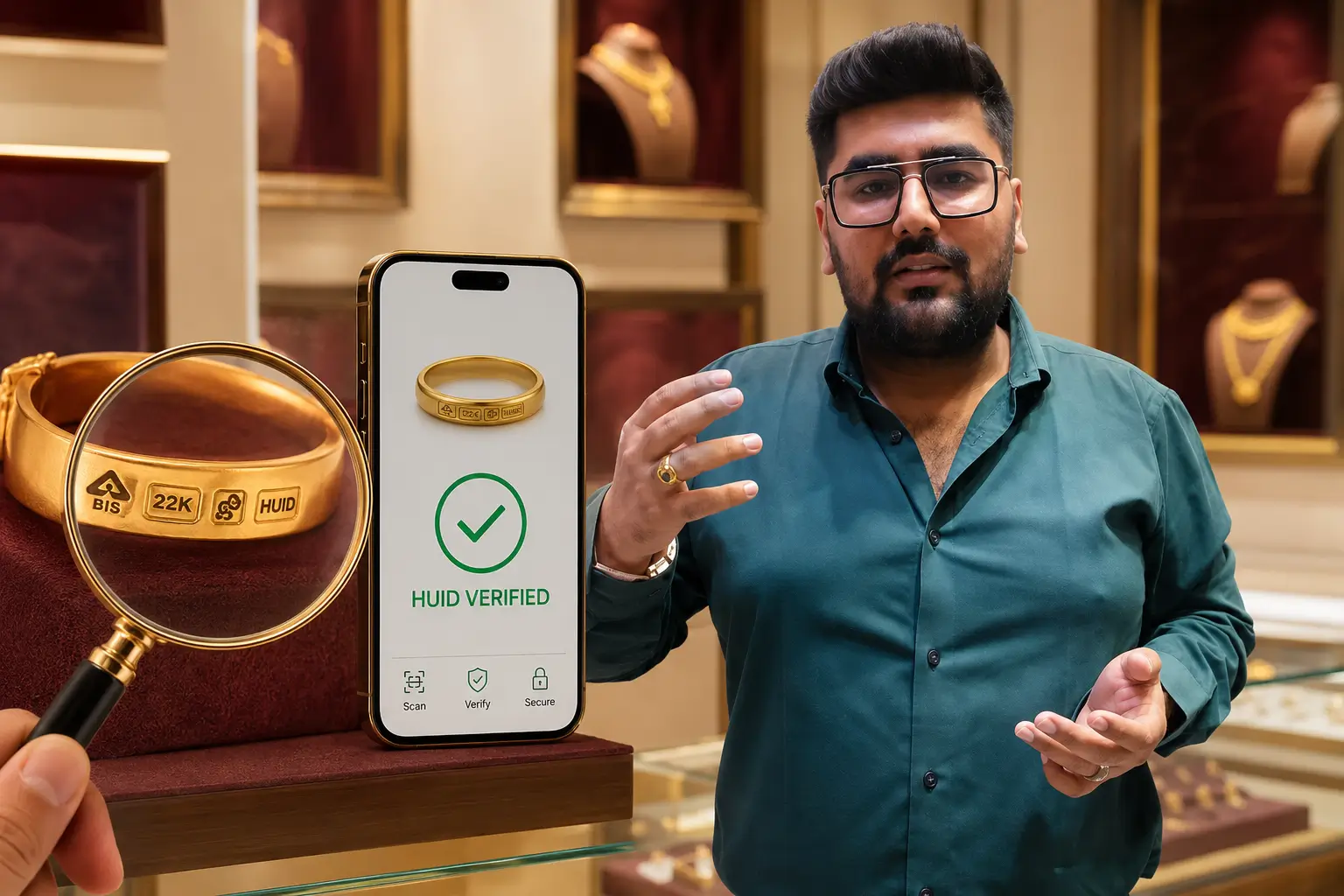
On every legitimately hallmarked piece of gold jewellery, there are four separate marks stamped or laser-etched onto the metal:
- The BIS Logo — a small triangular mark with ‘BIS’ inside.
- The Karat Purity Mark — indicates the fineness of the gold: 22K916 means 22 karat (91.6% pure gold), 18K750 means 18 karat (75%), 14K585 means 14 karat (58.5%).
- The Assaying Centre Mark — the identification code of the BIS-recognised centre that tested and hallmarked the piece.
- The 6-character HUID — the unique identifier for this specific piece.
If any of these four marks is missing, the piece is either not properly hallmarked, or was hallmarked before HUID became mandatory (pre-2021) — in which case it should have been re-hallmarked before being sold to you.
How to Verify a HUID in 30 Seconds
This is the part that matters. Anyone can check any HUID from any jeweller, at any time, for free.
Step 1: Download the BIS Care app from the Google Play Store or Apple App Store. It’s free, official, and takes 2 minutes to install.
Step 2: Open the app and tap the ‘Verify HUID’ option on the home screen.
Step 3: Enter the six-character HUID from your jewellery.
Step 4: The app instantly displays: the jeweller’s registered name and BIS licence number, the exact karat purity that was certified, the gold weight tested, the date the piece was hallmarked, and the assaying centre that did the testing.
If the details match what your jeweller told you and what your invoice says — you’re holding a genuinely hallmarked piece. If any detail doesn’t match, or if the app returns ‘HUID not found,’ something is wrong. Go back to the jeweller and ask questions.
What If Your Old Jewellery Doesn't Have HUID?
If you own gold jewellery bought before 2021, it may carry an older hallmark format (BIS logo + karat + assaying centre + jeweller’s mark, but no HUID). That’s normal. Those pieces were hallmarked under the old system and remain legitimate.
However, if you want to sell or exchange those pieces, most jewellers will re-test the purity before setting the buyback value — so you’re not disadvantaged by not having a modern HUID.
If your old jewellery has no hallmark at all, you can take it to any BIS-recognised assaying centre and get it independently tested for a small fee (typically ₹200-₹500 per piece).
Why This Matters Even If You Trust Your Jeweller
Even with a jeweller you’ve bought from for twenty years, HUID verification protects you against something the jeweller may not control — mistakes in the supply chain, misprinted certificates, occasional processing errors at the assaying centre.
We encourage every Tritiya customer to verify their HUID within a week of purchase. Not because we doubt our own jewellery — we test and hallmark every piece before it leaves — but because independent verification is what makes the whole system trustworthy. If a customer catches an error, we fix it immediately. That’s how it should work.
If you’re buying gold as a gift, verifying the HUID is also a small act of confidence in the piece. You know exactly what you’re giving.
Red Flags to Watch For
A few situations that should raise questions:
The jeweller can’t show you the HUID. Every hallmarked piece has one. If a jeweller says ‘the mark is worn off’ or ‘we haven’t marked this one yet,’ walk away.
The HUID isn’t in the BIS Care app. Every registered HUID is in the system. If a HUID returns ‘not found,’ the piece is either not legitimately hallmarked or the HUID number is fake.
The karat on the app doesn’t match the invoice. If your invoice says 22KT but the HUID reveals 20KT, you’re being overcharged. Confront the jeweller with the app screen.
The jeweller name in the app is different from where you bought. This can happen legitimately (some jewellers sell hallmarked pieces from other manufacturers), but you should be told upfront.
What About Diamond Certification?
The Tritiya Standard
Quick Recap
- All gold jewellery sold in India today must be BIS hallmarked with HUID (six-character unique code)
- Look for four marks: BIS logo, karat purity, assaying centre code, HUID
- Verify HUID for free in the BIS Care app — takes 30 seconds
- If HUID isn’t in the app, or details don’t match your invoice, that’s a red flag
- Diamond certification is separate — ask for the IGI/SGL certificate on diamond pieces
Buying gold in India has never been more transparent. The tools are free, the system is honest, and you don’t need to trust anyone’s word — you can check for yourself. Do it once and it becomes a habit for life.